
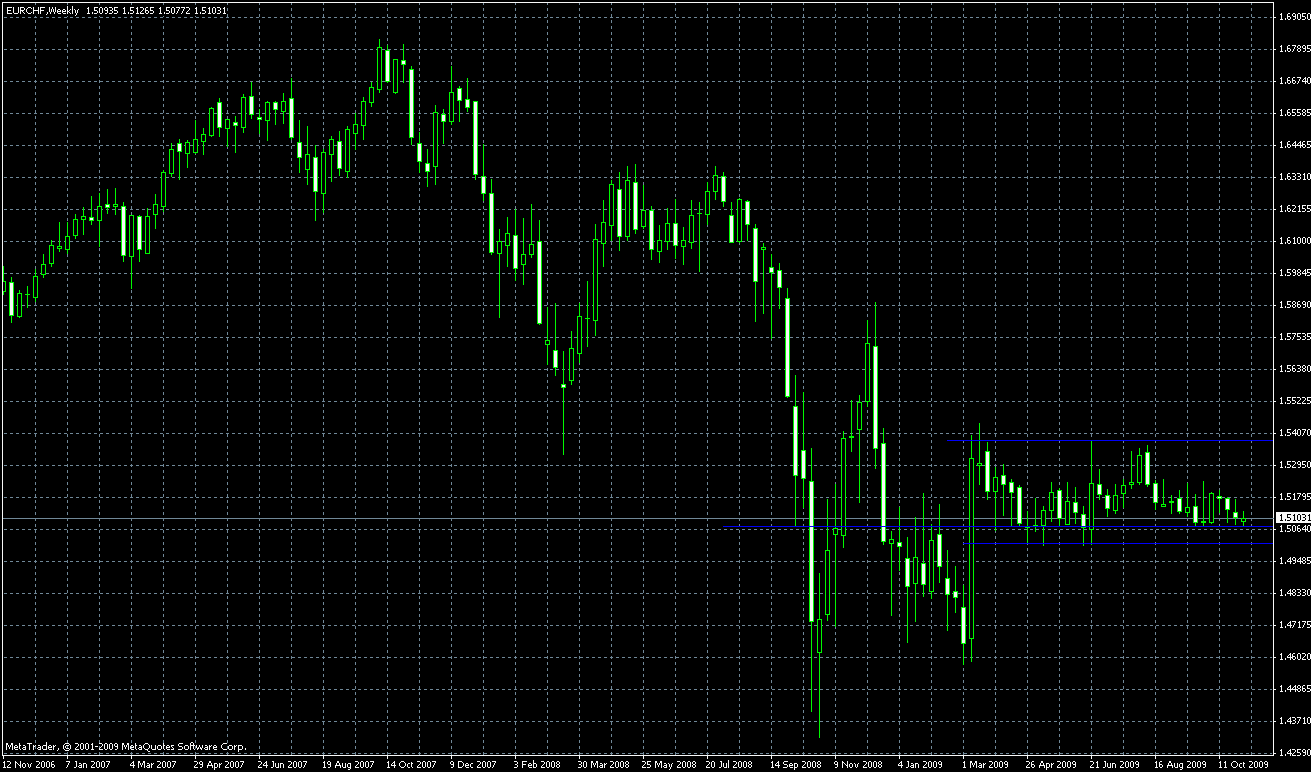
The weekly chart of EUR/CHF currency pair is showing a rather rare pattern — a horizontal channel formed by the support and resistance levels. The support level is a double bottom with two lines close to one another. The bearish breakout through such support level can be a very strong signal. EUR/CHF is known to be a rather stable pair as both currencies are European but the Swiss franc (CHF) tends to gain during elevated
Wednesday, November 11, 2009
EUR/CHF Double Bottom Horizontal Channel
MetaTrader 5 New Position System
The new position system of MetaTrader 5 (
The two presented charts depict the same USD/JPY market situation, processed with the same trading system but on two different platforms — MetaTrader 4 (first picture) and MetaTrader 5 (second picture).
On about August 10 we enter a Short Position by sending a Sell Order @ 97.67 to our MT4 terminal. On about October 9 we realize that it’s a good opportunity to enter a

On about August 10 we enter a Short Position by sending a Sell Order @ 97.67 to our MT5 terminal. On about October 9 we realize that it’s a good opportunity to enter a

In both cases we earned the same profit — 1,145 pips and paid the same amount of pips in spread (equal to 2 closed positions). We used the same system and orders to operate the market and we’ve got the same results. In fact, there is one thing different in term of profit/loss with MT5 and MT4 — it’s the amount of the rollover interest, since you reduce the number of days, during which the positions are accountable for such interest, you reduce your losses from the overnight swap charged on your trading account. The given example can be scaled out to any amount of the interconnected positions. Even a grid trading strategy can be compressed into
Forex Technical Analysis for 11/09—11/13 Week
EUR/USD trend: hold.
GBP/USD trend: sell.
USD/JPY trend: sell.
EUR/JPY trend: hold.
GBP/JPY trend: sell.
| Floor Pivot Points | |||||||
|---|---|---|---|---|---|---|---|
| Pair | 3rd Sup | 2nd Sup | 1st Sup | Pivot | 1st Res | 2nd Res | 3rd Res |
| EUR/USD | 1.4384 | 1.4505 | 1.4676 | 1.4797 | 1.4967 | 1.5088 | 1.5259 |
| GBP/USD | 1.5995 | 1.6128 | 1.6369 | 1.6502 | 1.6743 | 1.6876 | 1.7117 |
| USD/JPY | 87.22 | 88.33 | 89.09 | 90.20 | 90.97 | 92.08 | 92.85 |
| EUR/JPY | 127.31 | 129.44 | 131.42 | 133.55 | 135.54 | 137.66 | 139.65 |
| GBP/JPY | 141.72 | 144.04 | 146.65 | 148.97 | 151.58 | 153.90 | 156.51 |
| Woodie’s Pivot Points | |||||
|---|---|---|---|---|---|
| Pair | 2nd Sup | 1st Sup | Pivot | 1st Res | 2nd Res |
| EUR/USD | 1.4517 | 1.4701 | 1.4809 | 1.4992 | 1.5101 |
| GBP/USD | 1.6155 | 1.6423 | 1.6529 | 1.6797 | 1.6903 |
| USD/JPY | 88.24 | 88.92 | 90.12 | 90.80 | 92.00 |
| EUR/JPY | 129.40 | 131.35 | 133.52 | 135.47 | 137.63 |
| GBP/JPY | 144.11 | 146.79 | 149.04 | 151.72 | 153.97 |
| Camarilla Pivot Points | ||||||||
|---|---|---|---|---|---|---|---|---|
| Pair | 4th Sup | 3rd Sup | 2nd Sup | 1st Sup | 1st Res | 2nd Res | 3rd Res | 4th Res |
| EUR/USD | 1.4686 | 1.4766 | 1.4793 | 1.4820 | 1.4873 | 1.4900 | 1.4927 | 1.5007 |
| GBP/USD | 1.6404 | 1.6507 | 1.6542 | 1.6576 | 1.6644 | 1.6679 | 1.6713 | 1.6816 |
| USD/JPY | 88.83 | 89.35 | 89.52 | 89.69 | 90.04 | 90.21 | 90.38 | 90.90 |
| EUR/JPY | 131.15 | 132.28 | 132.66 | 133.03 | 133.79 | 134.17 | 134.54 | 135.67 |
| GBP/JPY | 146.54 | 147.90 | 148.35 | 148.80 | 149.71 | 150.16 | 150.61 | 151.97 |
| Tom DeMark’s Pivot Points | |||||
|---|---|---|---|---|---|
| Pair | EUR/USD | GBP/USD | USD/JPY | EUR/JPY | GBP/JPY |
| Resistance | 1.4882 | 1.6623 | 91.53 | 134.54 | 150.27 |
| Support | 1.4590 | 1.6249 | 89.65 | 130.43 | 145.34 |
| Fibonacci Retracement Levels | |||||
|---|---|---|---|---|---|
| Pairs | EUR/USD | GBP/USD | USD/JPY | EUR/JPY | GBP/JPY |
| 100.0% | 1.4917 | 1.6635 | 91.31 | 135.68 | 151.29 |
| 61.8% | 1.4806 | 1.6492 | 90.59 | 134.10 | 149.41 |
| 50.0% | 1.4772 | 1.6448 | 90.37 | 133.62 | 148.83 |
| 38.2% | 1.4737 | 1.6404 | 90.15 | 133.13 | 148.25 |
| 23.6% | 1.4695 | 1.6349 | 89.88 | 132.53 | 147.53 |
| 0.0% | 1.4626 | 1.6261 | 89.43 | 131.56 | 146.36 |
Inverse Correlation between Dollar and Everything Else…Still
Almost two months ago, I wrote a series of posts (Dollar Down, Everything Else Up and Dollar Down, Gold Up) with self-explanatory titles. Last week, the Wall Street Journal finally got around to covering this story, and were able to quantify the extent of the trend with the use of statistical analysis. Accordingly, they observed an incredible 71% correlation between the Dollar and the S&P 500, compared to an average correlation of 2%. This implies that every 1% rise in the S&P is matched by a .71% fall in the value of the Dollar, and vice versa.
Furthermore, this trend appears to be both strengthening and spreading. The average correlation between the Dollar and stocks since July is 60%; given that it’s now 71%, this suggests that it was closer to 50% over the summer. In addition, the correlation between stocks and oil has touched 75%, the highest level since 1995. By extension, this implies a proportionately high correlation between the Dollar and gold. In short, the notion that as the Dollar is tanking, virtually every other commodity/asset under the sun is rising, now has some weight behind it.

Understanding the basis for this relationship is not complicated. You can think of it in terms of the Fed’s liquidity program or in terms of the carry trade, but regardless of what you call it, the concept is the same. Basically, the Federal Reserve Bank has printed nearly $2 Trillion as part of its quantitative easing program. For better or worse, most of this money found its way into the markets, rather than into the economy. Investors have been faced with the dilemma of either holding the currency in cash or investing it. (Here, I would argue that “speculate” is a more appropriate descriptor than “invest,” but anyway…) The simultaneous rise in stocks, bonds, emerging market currencies, commodities, and even real estate is proof enough about where that money went.
Stepping outside of forex markets a moment, the fact that all asset prices are rising in unison suggests that a new bubble is forming. Normally, one would expect that in a bull market, some assets would outpace others, but in this case, it seems that fundamentals are being pushed to the backburner, and investors are piling into anything and everything that’s liquid. Even traditional relationships, like that which leads bond prices to fall as stock prices rise seems to have broken down.
Getting back to the Dollar, the fact that bubbles are forming in stocks/bonds/commodities probably means that an inverse bubble is forming under the Dollar. One can draw understanding from last year’s partial collapse of the Yen carry trade, which began to deflate after several reliably strong years. The same could very well happen to the Dollar carry trade.
If and when the Fed raises interest rates, and/or begins to draw the excess liquidity out of the markets by offloading its inventory of securities, well, the markets should witness a simultaneous correction. How violent the correction is depends largely on the degree to which the markets anticipated it as well as the finesse of the Fed. If everybody rushes for the exits at the same time, it could create the same kind of panic that ensued after Lehman Brothers went bankrupt, whereby asset prices collapsed and the markets flooded into the Dollar.
History is never far from repeating itself.
Forex Implications of China-US Economic Codependency
The Economist recently published a special report on China and America (”Round and round it goes“). As the title suggests, the article described the increasing interdependency between the economies of the US and China. In a nutshell, China maintains an undervalued currency, in order to stimulate exports. The resulting overseas (American) demand puts upward pressure on the RMB, which China defuses by buying US Treasury securities. This results in artificially low US interest rates, causing American consumers to import more, putting even more pressure on the RMB, which is further defused by buying more US Treasuries. And the cycle continues ad nauseum.
The article focused primarily on the political side of this precarious relationship, at the expense of the financial implications. It got me thinking about the forex forces at work, and how a disruption in the cycle could have tremendous ramifications for currency markets. It’s clear that in its current form, this system keeps the Yuan artificially low, but does that means that the Dollar is also being kept artificially high.
Given the depreciation of the Dollar over the last six months, this seems almost hard to believe. Over the same time period, though, China (as well as many other Central Banks) have vastly increased their Treasury holdings. This would seem to imply that indeed, the Dollar’s fall has been slowed to some extent by the actions of China. It’s kind of a paradox; as US consumers recover their appetite for Chinese goods, the Dollar should decline. But as China responds by plowing all of those Dollars back into the US, then the net effect is zero.

As the Economist article intimated, there are a couple of developments that would seem to upset this equilibrium. The first would be if the Central Bank of China began diversifying its forex reserves into other currencies. By definition, however, it would be impossible for China to continue pegging the RMB to the Dollar without simultaneously buying Dollars. Thus, the day that China stops recycling its export proceeds into the US, the RMB would start to appreciate, almost instantaneously. In addition, the sudden surcease in US Treasury bond purchases would cause interest rates to rise. Both higher rates and a more expensive currency would presumably result in lower demand for Chinese exports, and hence eliminate some of the need to recycle its trade surplus back into the US. In this way, we can see that China’s Treasury purchases are actually self-fulfilling. The sooner it stops purchasing them, the sooner it will no longer need to purchase them.
I’m tempted to elaborate further on this point, but it seems that I’ve already taken it to its logical conclusion. China must recognize the dilemma that it faces, which is why it refuses to break from the status quo. If it allows the Yuan to appreciate, it will naturally face a decline in exports AND the relative value of its US Treasury holdings will decline in RMB terms. Both would be painful in the short-run. However, by refusing to concede the un-sustainability of its forex/economic policy, China is merely forestalling the inevitable. With every passing day, the adjustment will only become more painful.
How will Foreign Investment Tax Affect the Real?
On October 20, the executive office of the government of Brazil enacted an emergency measure, calling for a 2% tax on on all foreign capital inflows. And with one foul swoop, this year’s 35% rise in the Real had come to an end, right?
The tax certainly took investors by surprise, with the Brazilian stock market falling by 3% and the Real falling by 2%, the largest margins for both in several months. The tax is comprehensive and applies to essentially to all foreign capital deployed in Brazilian capital markets, whether fixed income, equities, or currencies. While the tax doesn’t apply to those currently invested in Brazil, the possibility that it would cause potential investors to stay away was enough to cause a sell-off.
The ostensible reason for the tax levy is to prevent a further rise in the Real. By most measures, the currency’s rise has been excessive, more than erasing the losses incurred during the credit crisis. The concern is that a more expensive currency will derail the Brazilian economic recovery before it has a chance to firmly get off the ground. “Brazil’s currency needs to weaken as much as 19 percent for sustainable economic growth, said Nelson Barbosa, the Brazilian Finance Ministry’s top policy adviser.”
According to cynics, however, the tax is a backhanded effort to raise revenue to fund a growing budget deficit. The government continues to spend money (perhaps to offset the negative impact on exports brought on by the Real’s rise) as part of its stimulus plan, but is increasingly tapping the bond markets to do so. The tax is expected to bring in an impressive $2.3 Billion over the next year, which could go part of the way towards fixing the government’s fiscal problems.
The real question, of course, is how the Real will fare going forward. The initial reaction, as I said, was ‘The Party’s over…‘ But investors with a longer-term horizon aren’t fretting. “In the medium term, the measure will have a limited impact. The fundamentals point to a stronger real, with commodities rising and the dollar weakening globally,” asserted one economist. While investors aren’t happy about paying an arbitrary 2% fee to the government, such pales in comparison to the 10%+ returns that investors still aim to reap from investing in Brazil over the long-term.
Ignoring the possible bubbles forming in Brazilian capital markets (admittedly, a dubious suggestion), Brazil still looks like a good bet, especially on a comparative basis. Interest rate futures point to a benchmark interest rate of 10.3% at this time next year, compared to ~1% in the US. Even after accounting for inflation and the 2% tax levy, the yield spread between Brazil and the US remains impressive. For that reason, the Real has already stalled in its expected fall against the US Dollar, standing only 1.7% below where it was on the day the tax was declared.

It’s unclear how determined the Brazilian government is towards pushing down the Real. The comments by its finance minister suggest that the consensus is that it is not slightly – but extremely overvalued. Thus, it’s likely that the government will enact other aggressive measures to prevent it at least from rising further. It continues to buy Dollars on the spot market, and is trying to make it easier for Brazilians to take money out of Brazil. It is not yet ready to tamper with its floating currency, but by its own admission, the “government was studying additional measures to regulate the heavy inflow of foreign investments and its impact on the country’s currency.”
There are also implications for other (emerging market) currencies. As I wrote earlier this week (”Central Banks Prop Up Dollar“) a number of Central Banks have already intervened or are currently mulling intervention in forex markets, to push down their currencies. You can be sure that other governments will be studying the situation in Brazil closely, with the possibility of implementing such policies themselves.
Monday, November 9, 2009
Forex Day Trading

Forex Day Trading.News.Forex Day Trading.News.Forex Day Trading.News
Forex Day Trading.News
With the increasing popularity of working from home, forex trading day for many people has become one of the best earnings. You claim that they teach you how to paper a week to thousands and thousands of dollars in ads can get many currency trading courses or seminars.
So, why so many people trade forex daily claimed that it is not successful, stop? Here is the key
1. Lack of patience: Trading foreign exchange earnings of the day most people are unlikely to be decided. They thought they could study in a few weeks is only a few thousand. It really is impossible, kurva 3 years to learn about foreign currency trading is six months, depending on how hard you go and passionate. Because of this, your patience and time spent with yourself to practice what you learn in the demo account.
2. Lack of knowledge: for some people as a long-term career to make a foreign currency day trading, but want to spend time and money to obtain foreign exchange for better training before they started trading is. The number one reason that people yesterday suffered their accounts because they lack knowledge.
So, if you really interested in foreign currency business day if you exercise long-term career, you should time the books, courses or blog as a forex day trading tips with other operators read.
Now you can actually read the article is a good start. Believe me, to know all possible fitness forex day trading, but only you can do that is possible, not even the best foreign exchange custodian or courses for you.
FOREX LOAN

NEED A LOAN TO TRADE FOREX?
Well, don’t do it! Clear and simple, do not take out a loan to trade Forex. It’s stupid. It’s risky, and it could leave you owing hundreds of thousands of dollars, even if you only take out a few thousand. Any sort of investing should be done with funds you can only afford to lose, bottom line. Trading Forex is a risk, why would you compound that risk for loss with having to pay a loan for Forex every month? Makes no Sense, quick way to lose more money than before.
Where to get Funding For Forex Then?
Honestly, I’m not sure. How does anyone get financing for ideas? Talk to relatives, wait for someone to die. The possibilities are limiteless or limited based on your personal situation. All I know is, I’d be a mother **(#$@#(&$# if I told you it were a good idea to take out a loan to trade in the Forex market. However, if you do have outstanding bills or payments on credits cards that you are looking to consolodate your debt, you really need to try out Prosper. Prosper is the most painless way to take out a loan I’ve ever seen. The only problem I encountered was the fact that I don’t have an official job, I work for myself and lack paystubs and a “pretty” tax return to show their credit department. THE ONLY CATCH. But hey, can you really expect them to let you take out a loan without a little reassurance you can pay it back? Other than that Prosper really is the coolest site you’ll ever see with respect to borrowing money. I’m sure most of you aren’t there yet, but you can also lend money with sweet returns.
Ok, so the most important thing to remember is not to take out a Loan for Forex, whatever you do! Taking out a loan for trading Forex is the dumbest thing a human being can do with respcet to the Forex market. With proper money management you can turn $10,000 into $100,000 very quickly. One of my former Forex mentors had 600% return in under 2 months, if he can do that, I’m sure with some help you can make at least 10-20% with your Forex account a month. Period. I hope this little entry about Forex LOANS helped you out.
Forex Broker Texas
Forex brokers are going to give you all types of information and advice about where you can invest and how you can invest with foreign companies. Forex brokers are found in large commercial investing firms, in most larger banks, and now with the help of the internet you can find many Forex brokers online.

Local Companies
Accent Travel/American Express
512-338-2828
3737 Executive Center Dr #100
Austin, TX
512-338-2828
3737 Executive Center Dr #100
Austin, TX
J L Money Exchange
915-533-5784
912 S Stanton St
EI Paso, TX
915-533-5784
912 S Stanton St
EI Paso, TX
Monumex Money Exchange
915-577-9185
100 E San Antonio Ave
EI Paso, TX
915-577-9185
100 E San Antonio Ave
EI Paso, TX
Valuta Corp
915-544-1152
300 S Mesa St
EI Paso, TX
915-544-1152
300 S Mesa St
EI Paso, TX
Alfa Money Exchange
(956) 791-0880
1208 Grant St
Laredo, TX
(956) 791-0880
1208 Grant St
Laredo, TX
Grupo Cambiario USA Mex Inc
(956) 725-7196
918 Santa Ursula Ave
Laredo, TX
(956) 725-7196
918 Santa Ursula Ave
Laredo, TX
La Mina Money Exchange
(956) 717-1478
803 San Dario Ave
Laredo, TX
(956) 717-1478
803 San Dario Ave
Laredo, TX
Forex trading journal
(232) 344-8322
Texas, TX
(232) 344-8322
Texas, TX
American Express
469-467-0675
5700 Legacy Dr
Plano, TX
469-467-0675
5700 Legacy Dr
Plano, TX
High Value Inc
(956) 712-3513
820 Santa Ursula Ave
Laredo, TX
(956) 712-3513
820 Santa Ursula Ave
Laredo, TX

 Forex Broker Texas
Forex brokers are going to give you all types of information and advice about where you can invest and how you can invest with foreign companies. Forex brokers are found in large commercial investing firms, in most larger banks, and now with the help of the internet you can find many Forex brokers online.
Local CompaniesAccent Travel/American Express 512-338-2828 3737 Executive Center Dr #100 Austin, TX J L Money Exchange 915-533-5784 912 S Stanton St EI Paso, TX Monumex Money Exchange 915-577-9185 100 E San Antonio Ave EI Paso, TX Valuta Corp 915-544-1152 300 S Mesa St EI Paso, TX Alfa Money Exchange (956) 791-0880 1208 Grant St Laredo, TX Grupo Cambiario USA Mex Inc (956) 725-7196 918 Santa Ursula Ave Laredo, TX La Mina Money Exchange (956) 717-1478 803 San Dario Ave Laredo, TX Forex trading journal (232) 344-8322 Texas, TX American Express 469-467-0675 5700 Legacy Dr Plano, TX High Value Inc (956) 712-3513 820 Santa Ursula Ave Laredo, TX |
Forex brokers are going to give you all types of information and advice about where you can invest and how you can invest with foreign companies. Forex systems are not available through all types of commercial investing companies but you can find a few Forex brokers in most all areas of the world. Forex brokers are found in large commercial investing firms, in most larger banks, and now with the help of the internet you can find many Forex brokers online. Use a Forex broker if you want to learn more about how to invest, where to invest, and how much money you need to invest in a Forex system right now.
Forex brokers are going to tell you what the minimums are. In some cases, you can invest as little as five dollars to open a Forex trading account. In some areas, and for some investment companies you must invest a minimum of $200 or even $500. It is important to remember that every investment firm is different, and will have set minimums for their business to take place.
Fees through a Forex broker will be based on the amount of the transaction and the type of transaction that you are completing. Moving from fund to fund or from Forex account to another Forex account you will incur the largest types of fees, but be sure to read the fine print on the Forex broker site where you intend to do business to be sure. Forex brokers make their money on the fees they bill when helping clients move money, and put money into investments.
A Forex broker should be a person you can trust, understand, and that you feel is honest with you. A Forex broker is one that you should not receive phone calls from, urging you to put large amounts of money into an account, right now. A Forex broker will present you with information about an investment, and then allow you time to make up your own mind if you are interested in the investment or not. A pushy broker is one that could be trying to earn a commission or could be trying to scam you. Again, your Forex broker is a broker you should feel comfortable in dealing with on a daily or weekly basis, but for many people, you may only talk to your Forex broker once a month or even less than that.
Investing money is a big decision. When deciding what broker Forex advice to take, or where to seek broker Forex advice you can use the links on these pages, or you can use your local yellow pages to find a possible Forex broker in your town or city. Not many Forex brokers are located in small towns or cities but in larger areas where the population is larger and more people have a need for such Forex and investing infor
Saturday, November 7, 2009
How do you find the right structured settlement broker

If you've come to this stage of your search, you've already made the decision to either sell your structured settlement payment or to find a broker to deal with the company that is paying out your structured settlement, either way; you know you need to make the right decision. Of course it is, choosing someone to broker your structured settlement is pivotal to maintain a healthy financial situation currently and in the future. Depending on whom you choose you can feel safe in your investment and decisions or petrified. Finding the right structured settlement broker, is as simple as knowing exactly what you should expect from a professional structured settlement broker. So, to find you the perfect broker, we've discussed in the following article exactly what your structured settlement broker should be doing for you. Before you accept a broker, please make sure that all the services we are discussing is something they offer in their own services to you.
A structured settlement broker can help you gain a fair value of the costs and projected income that you will receive from a specific structured settlement. Your broker, ideally, should be giving you all the information that you need to make a wise decision for your future lifestyle and monetary needs. Another responsibility of your structured settlement broker is to do financial analysis for you, derive all of the present and future costs of your settlement, and interacts with the Medicaid and to negotiate with and on your behalf to get the best possible settlement for you. If you have not yet decided the contractual terms of your structured settlement plans then your broker will work with your attorneys or in most cases have their own legal team work out the details to avoid numerous litigation costs for you.
A broker should ideally sit down with your attorney and discuss all the financial implications of your case. Having an expertise in this field will better enable them to estimate the medical expenses endured, present income and a loss of income for the bodily injuries that were created while this court case was in process and before the court case actually begun. Even after the court case has been completed, your broker should be there making sure that the negotiation process was followed accurately and according to the official guidelines that were originally asked for. With a structured settlement broker, your attorney will be able to create a powerful case for you in which ever matter is currently pending. Due to the fact that not all attorneys are experts in structured settlements, it is important to have someone who will guide them in that specific area.
A broker for a structured settlement firm will be able to offer you various payment options and explain the difference between each one, according to your specific life-style and future monetary needs and depending on the injury that you currently sustained, they can offer you the best course of action. Make sure that your broker sits down with you and explains everything to you before getting an official declaration for the structured settlement plan. Only if these few requirements are met of your broker, then you should hire him. Remember, this is an important decision that should not be taken lightly.
Why You Should Have a Structured Settlement Broker
Structured settlement brokers help people navigate the settlement procedure by providing information and explaining the advantages of the structured settlement process. Brokers can be valuable because they explain the stipulations and often try to implement a plan that meets your unique requirements.
Many people are a little scared to utilize a broker. Nonetheless, because of the detailed nature of a lot of structured settlements, most people would be well served by a competent and dependable structured settlement broker.
There are a few ways to locate a broker. Plenty of individuals ask an honest accountant or bank to mention a structured settlement broker that would be able to help both sides agree to acceptable terms. Others ask family members to propose someone they know who is reliable and competent. The Internet is another place where people go to find settlement brokers.
No matter where you go to seek your broker, make sure that they are competent and willing to represent your interests fully. Whether you are negotiating a settlement or attempting to sell your structured settlement, a useful broker will work fiercely to make sure that your requests are met.
Be sure that your broker is willing to charge you a reasonable fee for their services. Even though it is still a relatively new industry, there are particular professional values that they must keep up. Ultimately, nothing will provide you better consequences than having a solid sense of your own expectations and making sure that you hire somebody that is able to meet those expectations.
It is quite challenging for persons to navigate these settlements on their own. They are complicated and intricate. You need a broker to help you navigate the tricky fiscal terrain and help both parties decide on a good settlement. Just be sure that the structured settlement broker has your best interests in mind and has a solid idea of your financial circumstances.
Evelynn Gaines has been writing about financial matters for years. She has spent a lot of time working with people find lawsuit settlement. Be sure to read her other helpful insights into the structured settlement process
Choosing the Best Professional Forex Brokers
If you are thinking of getting in touch with USA forex brokers, there are some important factors you need to consider. It's actually not that tough to find one considering there are lots of these professionals out in the market today. The real challenge however is finding someone who can really bring you results and assure that you are going to get quality services out of your investment. Bear in mind that forex brokers' rates vary accordingly and they may turn out to be a bit pricey.
The reason why it is important to hire a forex broker that specifically trades in the US dollar currency is that it gives you exposure to experiential and technical aspects. The US currency is one of the most widely used trading money in the market today. It's like the base where other currencies peg their rates at so when the US dollar fluctuates, it tends to change the course of the trading market as well. Liquidity is something that you must expect when it comes to the trading game.
Here are some important points you might need to consider when it comes to choosing among USA forex brokers.
1. Is the forex broker duly regulated? - The US bank and its related financial agencies have a say on the players in the forex market. Therefore it is important that you get in touch with these types of people. The great thing about using forex brokers who are regulated is that they are quite meticulous with their process. They need to do this because aside from liaising with you and their business spread partners, they also need to submit their financial standing and reports to regulating authorities. This way, you are assured that you are getting in touch with reliable people with a solid reputation.
2. Be the one to specify your trading platform - Although forex brokers are known to employ their own trading platforms, it would still be best if you are the one who will be giving directions for this system. Your trading platform should depend on the amount of time you can devote on the project and your work system. There are many different kinds of trading systems which you can use. You can either choose to have your trading run on autopilot, you may want to purchase a licensed trading software, or simply log online to an open source trading network. If you are not yet familiar with these things then you can also ask the expertise of forex brokers to help you choose the platform that would suit you best.
3. Trading methods used - Aside from the trading platform being used, you should also delve deeper into the specifics of the trading methods being used by your preferred forex broker. Here is where things such as spread, funds safety, and fractional trading would come into picture. All of these key ingredients to facilitate your forex business.
Do not let yourself be overwhelmed with having plenty of choices for USA forex brokers. Make sure you trim them down to qualified individuals whom you feel comfortable to work with.
China simplifies forex rules to boost outbound investment
BEIJING: China's foreign exchange regulator said Wednesday it would loosen its controls on overseas investment procedures and foreign exchange management of domestic companies to boost outbound investment.
In a statement on its website, the State Administration of Foreign Exchange said a regulation, which will take effect on August 1, would simplify the examination and approval procedures for domestic companies with overseas investment plans.
Domestic companies would be allowed to register the source of their foreign exchange financing after their investment overseas instead of obtaining approval beforehand, according to the regulation.
The regulation would also allow domestic enterprises to finance overseas investment with domestic foreign exchange loans, purchases of foreign exchange with yuan, their own foreign currency funds and profits gained abroad.
Domestic companies would be able to transfer funds abroad before their overseas projects were established, after gaining approval from SAFE. The ceiling rate was 15 percent of the total project investment.
The SAFE would also improve supervision over overseas investment and step up supervision and management over the foreign exchange used in China's direct investment overseas.
The draft of the regulation had been posted on the SAFE website to solicit public opinion from May to June.


"Successful overseas investment could help domestic companies to expand their markets, providing solutions to overcapacity and weak internal demand," said Zhang Qizuo, vice president of the Sichuan-based Chengdu University.
The regulation would increase outbound investment and encourage more foreign exchange uses, so as to relieve pressure brought by China's rapid expansion of forex reserves, said Liu.
China's foreign exchange reserves hit a record $2.13 trillion at the end of June, the People's Bank of China said on its website Wednesday.
The Heart of Forex
The Heart of Forex - Custom indicator, 26 pairs and 9 TFs on 1 chart
Today i am talking about heart of Forex.Yeah it is title of my blog too.
ALL the time i was thinking, what kind of title i have chosen i mean thats sound weird.
But today i am wrong today , We are gonna talk about new Tool coded by my friend known as:
ALL the time i was thinking, what kind of title i have chosen i mean thats sound weird.
But today i am wrong today , We are gonna talk about new Tool coded by my friend known as:
HEART OF FOREX
Lets talk about it :::::::
I am pleased to show you the new tool I coded. The Heart of Forex. This great tool shows the real current price move for all TimeFrames. Display up to 26 pairs and 9 TimeFrames on the same chart. With only one eye, you'll be able to watch, compare all similar pairs and then see if they agree for the same direction. You no longer need to switch between pairs and TimeFrames.
This tool is based only on the price move. No indicators or any others tools are used for the calculation of HoF. Only Price Action.
Whatever your trading style, it's very important to know if the price move is a small isolated one or if the correlated pairs move all together. The more the similar pairs agree, the more the move is real and good for catch some pips.
After observing this tool, you will be able to define which similar pairs move together for a strong move.

<--- Full board or only selected pairs and TFs --->

It displays up to 26 pairs and 9 timeframes:
EURUSD-GBPUSD-AUDUSD-USDJPY-USDCHF-USDCAD-EURJPY-EURGBP-EURCHF
EURAUD-GBPJPY-GBPCHF-AUDJPY-NZDUSD-NZDJPY-AUDNZD-CHFJPY-EURCAD
AUDCAD-CADJPY-EURNZD-GBPAUD-GBPCAD-AUDCHF-NZDCHF-CADCHF
M1-M5-M15-M30-H1-H4-D1-W1-MN
You don’t need to apply more than one HoF. It displays ALL selected pairs and ALL selected TFs on the same chart regardless which chart or TF it’s apply on.
Here is how it looks with some selected pairs:

Parameters settable by users:
How to decrypt the Heart of Forex ?
5 different colors according to the current price move on a specific TimeFrame:
The values from -100 to +100 at the top of each column are strictly an average of all displayed TFs for a given pair. You can give more importance to some TFs by setting a k coefficient in the input parameters.
This k coefficient is very important according to your trading style. If you usually trade high TFs, you'll give more importance to these high TFs by setting a higher k. For those who like lower TFs (ie for scalping), then set a higher k for these small TFs.
Want to be a real successful trader? more info here ... and you'll catch the next move!!!
Feel free to contact me if you have any question.
I wish you a lot of pips..
FerruFx
I am pleased to show you the new tool I coded. The Heart of Forex. This great tool shows the real current price move for all TimeFrames. Display up to 26 pairs and 9 TimeFrames on the same chart. With only one eye, you'll be able to watch, compare all similar pairs and then see if they agree for the same direction. You no longer need to switch between pairs and TimeFrames.
This tool is based only on the price move. No indicators or any others tools are used for the calculation of HoF. Only Price Action.
Whatever your trading style, it's very important to know if the price move is a small isolated one or if the correlated pairs move all together. The more the similar pairs agree, the more the move is real and good for catch some pips.
After observing this tool, you will be able to define which similar pairs move together for a strong move.
<--- Full board or only selected pairs and TFs --->
It displays up to 26 pairs and 9 timeframes:
EURUSD-GBPUSD-AUDUSD-USDJPY-USDCHF-USDCAD-EURJPY-EURGBP-EURCHF
EURAUD-GBPJPY-GBPCHF-AUDJPY-NZDUSD-NZDJPY-AUDNZD-CHFJPY-EURCAD
AUDCAD-CADJPY-EURNZD-GBPAUD-GBPCAD-AUDCHF-NZDCHF-CADCHF
M1-M5-M15-M30-H1-H4-D1-W1-MN
You don’t need to apply more than one HoF. It displays ALL selected pairs and ALL selected TFs on the same chart regardless which chart or TF it’s apply on.
Here is how it looks with some selected pairs:
Parameters settable by users:
- All text and square zones colors
- The timeframes you want to display
- Set a k to apply for each timeframe. In other words, increase the k numbers for the TFs you want give more importance
- The pairs you want to display
How to decrypt the Heart of Forex ?
5 different colors according to the current price move on a specific TimeFrame:
- BLUE : strong up move for this TimeFrame
- LIGHT BLUE : up move for this TimeFrame
- YELLOW : move is flat for this TimeFrame
- ORANGE : down move for this TimeFrame
- RED : strong down move for this TimeFrame
The values from -100 to +100 at the top of each column are strictly an average of all displayed TFs for a given pair. You can give more importance to some TFs by setting a k coefficient in the input parameters.
This k coefficient is very important according to your trading style. If you usually trade high TFs, you'll give more importance to these high TFs by setting a higher k. For those who like lower TFs (ie for scalping), then set a higher k for these small TFs.
Want to be a real successful trader? more info here ... and you'll catch the next move!!!
Feel free to contact me if you have any question.
I wish you a lot of pips..
FerruFx
Friday, November 6, 2009
Forex Trading: Learn How To Read A Forex Quote
Forex Trading: Learn How To Read A Forex Quote

Forex is an abbreviated name for "foreign exchange." The Forex market is a non-stop cash market where the currencies of nations are bought and sold, typically via brokers. For example, you buy Euros, paying with U.S. Dollars, or you sell Euros for Japanese Yen.
The value of your Forex investment increases or decreases because of changes in the currency exchange rate or Forex rate. These changes often result from economic and political factors, such as the price of oil or political unrest. To better understand how the exchange rate can affect the value of your Forex investment, this article shows you how to read a Forex quote.
Forex quotes are always expressed in pairs. In the following example, your "pair" of currencies are the U.S. Dollar (USD) and the Euro (EUR). The Forex quote, USD/EUR = 265.50, means that one U.S. dollar is equal to 265.50 Euros. The currency to the left of the / (USD in this case) is referred to as base currency and its value is always 1. The currency to the right of the / (EUR in this case) is referred to as the counter currency. In this example, one USD can buy 265.50 EUR, since it is the stronger of the two currencies.
Because the U.S. dollar is regarded as the central currency of the Forex market, it is always treated as the base currency in any Forex quote where it is one of the pairs. Incidentally, the U.S. Dollar is involved in nearly 90% of all Forex transactions.
In this example, your "pair" of currencies are the Japanese Yen (JPY) and the Euro (EUR). The Forex quote, JPY/EUR= 175.10, means that one Japanese Yen is equal to 175.10 Euros. The currency to the left of the / (JPY in this case) is referred to as base currency and its value is 1. The currency to the right of the / (EUR in this case) is referred to as the counter currency. In this example, one JPY can buy 175.10 EUR, since it is the stronger of the two currencies.
The goal of any Forex trading system is to profit from foreign currency movements. This requires adequate training in basic Forex principles, such as performing a Technical Analysis, using Forex charts and Stop/Loss tools, and keeping up-to-date with economic and political events. In a sense, Forex training never ends.
Gregory DeVictor is a consultant who has been developing and marketing web sites since 1999. Learn what you need to know to get started in Forex trading and how to develop a successful.
Hope you understand and try to practice too wish you best luck dont forget
Forex rocks
FOREX : Dutch Disease
Dutch Disease
FORex and its disease sound weird but thats true. Forex gets diseases too. Now a days our is going quite down.We have to take steps and make it economyhealthy which is not only good for economy, we but our next generation too.
Forex is not just getting money and controlling country its same like heart of country progress we need to find solution or we could be doomed....
Let me tell you what is this dutch disease briefly :)

 Investopedia explains Dutch Disease
The term "Dutch disease" originates from a crisis in the Netherlands in the 1960s that resulted from discoveries of vast natural gas deposits in the North Sea. The newfound wealth caused the Dutch gilder to rise, making exports of all non-oil products less competitive on the world market.
In the 1970s, the same economic condition occurred in Great Britain, when the price of oil quadrupled and it became economically viable to drill for North Sea Oil off the coast of Scotland. By the late 1970s, Britain had become a net exporter of oil; it had previously been a net importer. The pound soared in value, but the country fell into recession when British workers demanded higher wages and exports became uncompetitive.
Critics say you can't blame such economic hardships on just one factor (say, rising oil prices) because there are so many other variables at play in the economy.
Forex is not just getting money and controlling country its same like heart of country progress we need to find solution or we could be doomed....
Let me tell you what is this dutch disease briefly :)
What Does Dutch Disease Mean?
An economic condition that, in its broadest sense, refers to negative consequences arising from large increases to a country's income. Dutch disease is primarily associated with a natural resource discovery, but it can result from any large increase in foreign currency, including foreign direct investment, foreign aid or a substantial increase in natural resource prices.
This condition arises when foreign currency inflows cause an increase in the affected country's currency. This has two main effects for the country with Dutch disease:
1. A decrease in the price competitiveness, and thus the exports, of its manufactured goods
2. An increase in imports
In the long run, both these factors can contribute to manufacturing jobs being moved to lower-cost countries. The end result is that non-resource industries are hurt by the increase in wealth generated by the resource-based industries.
An economic condition that, in its broadest sense, refers to negative consequences arising from large increases to a country's income. Dutch disease is primarily associated with a natural resource discovery, but it can result from any large increase in foreign currency, including foreign direct investment, foreign aid or a substantial increase in natural resource prices.
This condition arises when foreign currency inflows cause an increase in the affected country's currency. This has two main effects for the country with Dutch disease:
1. A decrease in the price competitiveness, and thus the exports, of its manufactured goods
2. An increase in imports
In the long run, both these factors can contribute to manufacturing jobs being moved to lower-cost countries. The end result is that non-resource industries are hurt by the increase in wealth generated by the resource-based industries.
The term "Dutch disease" originates from a crisis in the Netherlands in the 1960s that resulted from discoveries of vast natural gas deposits in the North Sea. The newfound wealth caused the Dutch gilder to rise, making exports of all non-oil products less competitive on the world market.
In the 1970s, the same economic condition occurred in Great Britain, when the price of oil quadrupled and it became economically viable to drill for North Sea Oil off the coast of Scotland. By the late 1970s, Britain had become a net exporter of oil; it had previously been a net importer. The pound soared in value, but the country fell into recession when British workers demanded higher wages and exports became uncompetitive.
Critics say you can't blame such economic hardships on just one factor (say, rising oil prices) because there are so many other variables at play in the economy.
Thursday, November 5, 2009
Chart Patterns and Technical Indicators
Chart Patterns and Technical Indicators
If you are interested in learning more about various chart patterns that can be used in Forex trading or need to gain some basic knowledge on some simple technical indicators, then the latest free
Failed Correction on EUR/USD on More Good Data
Failed Correction on EUR/USD on More Good Data
EUR/USD failed to to demonstrate a technical correction after the yesterday’s record fast growth, as some more good data on the employment market came out in U.S. today. During the early trading session, a downward movement was rather significant in euro/dollar market but the pair quickly recovered after the reports were released. EUR/USD is now trading near 1.4884.
Nonfarm business sector productivity of labor rose by 9.5% (annual rate) during the third quarter of 2009, following 6.6% increase during the second quarter. A growth of productivity by 6.5% was anticipated by the economic analysts. The improved productivity is a direct result of a higher unemployment, caused by laying off the least effective works.
Initial jobless claims were reported at 512k for the last week — down from 532k claims during the previous week. A drop to 522k was expected by the currency traders today.
EUR/USD Beats Weekly High on Fed Optimism
EUR/USD Beats Weekly High on Fed Optimism
EUR/USD showed the biggest daily growth since early September today and reached a new weekly high as the Federal reserve released a very optimistic monetary policy statement, citing faster recovery and lower inflation, which still allows interest rates as low as they are now. Although the amount of planned purchase of the debt was decreased, the news didn’t reduce the market optimism substantially. The better unemployment report and rising stock markets also helped the euro to rise against the U.S. dollar. EUR/USD is currently trading near 1.4835.
ADP unemployment rate showed a decrease by 203k job places in October in U.S. This number was much better than the previous month’s decline by 227k (revised positively from 254k drop) and only slightly above the expected -198k change.
ISM services index decreased from 50.9% to 50.6% in October, while the growth to 51.5% was expected by the traders and investors.
Crude oil inventories decreased by 4 million barrels last week and now are near the upper limit of the average range for this time of year. Total motor oil gasoline inventories dropped by 0.3 million barrels during that week.
FOMC released its monetary policy statement today, which was filled with the high level of optimism. They left the interest rate unchanged between 0% and 0.25% (which was expected by the Forex traders), but decreased the purchase of agency dept from $200 billion to $175 billion, which caused a rather sharp spike on EUR/USD:
Yesterday, a report on September factory orders showed a growth by 0.9%, which compares to 0.8% decline in August and is slightly above the median forecast by the market analysts, which stood at 0.8% gain…the Federal Reserve will purchase a total of $1.25 trillion of agency
mortgage-backed securities and about $175 billion of agency debt. The amount of agency debt purchases, while somewhat less than the previously announced maximum of $200 billion, is consistent with the recent path of purchases and reflects the limited availability of agency debt.
How will Foreign Investment Tax Affect the Real?
How will Foreign Investment Tax Affect the Real?
On October 20, the executive office of the government of Brazil enacted an emergency measure, calling for a 2% tax on on all foreign capital inflows. And with one foul swoop, this year’s 35% rise in the Real had come to an end, right?
The tax certainly took investors by surprise, with the Brazilian stock market falling by 3% and the Real falling by 2%, the largest margins for both in several months. The tax is comprehensive and applies to essentially to all foreign capital deployed in Brazilian capital markets, whether fixed income, equities, or currencies. While the tax doesn’t apply to those currently invested in Brazil, the possibility that it would cause potential investors to stay away was enough to cause a sell-off.
The ostensible reason for the tax levy is to prevent a further rise in the Real. By most measures, the currency’s rise has been excessive, more than erasing the losses incurred during the credit crisis. The concern is that a more expensive currency will derail the Brazilian economic recovery before it has a chance to firmly get off the ground. “Brazil’s currency needs to weaken as much as 19 percent for sustainable economic growth, said Nelson Barbosa, the Brazilian Finance Ministry’s top policy adviser.”
According to cynics, however, the tax is a backhanded effort to raise revenue to fund a growing budget deficit. The government continues to spend money (perhaps to offset the negative impact on exports brought on by the Real’s rise) as part of its stimulus plan, but is increasingly tapping the bond markets to do so. The tax is expected to bring in an impressive $2.3 Billion over the next year, which could go part of the way towards fixing the government’s fiscal problems.
The real question, of course, is how the Real will fare going forward. The initial reaction, as I said, was ‘The Party’s over…‘ But investors with a longer-term horizon aren’t fretting. “In the medium term, the measure will have a limited impact. The fundamentals point to a stronger real, with commodities rising and the dollar weakening globally,” asserted one economist. While investors aren’t happy about paying an arbitrary 2% fee to the government, such pales in comparison to the 10%+ returns that investors still aim to reap from investing in Brazil over the long-term.
Ignoring the possible bubbles forming in Brazilian capital markets (admittedly, a dubious suggestion), Brazil still looks like a good bet, especially on a comparative basis. Interest rate futures point to a benchmark interest rate of 10.3% at this time next year, compared to ~1% in the US. Even after accounting for inflation and the 2% tax levy, the yield spread between Brazil and the US remains impressive. For that reason, the Real has already stalled in its expected fall against the US Dollar, standing only 1.7% below where it was on the day the tax was declared.
It’s unclear how determined the Brazilian government is towards pushing down the Real. The comments by its finance minister suggest that the consensus is that it is not slightly – but extremely overvalued. Thus, it’s likely that the government will enact other aggressive measures to prevent it at least from rising further. It continues to buy Dollars on the spot market, and is trying to make it easier for Brazilians to take money out of Brazil. It is not yet ready to tamper with its floating currency, but by its own admission, the “government was studying additional measures to regulate the heavy inflow of foreign investments and its impact on the country’s currency.”
There are also implications for other (emerging market) currencies. As I wrote earlier this week (”Central Banks Prop Up Dollar“) a number of Central Banks have already intervened or are currently mulling intervention in forex markets, to push down their currencies. You can be sure that other governments will be studying the situation in Brazil closely, with the possibility of implementing such policies themselves.
Subscribe to:
Comments (Atom)

